
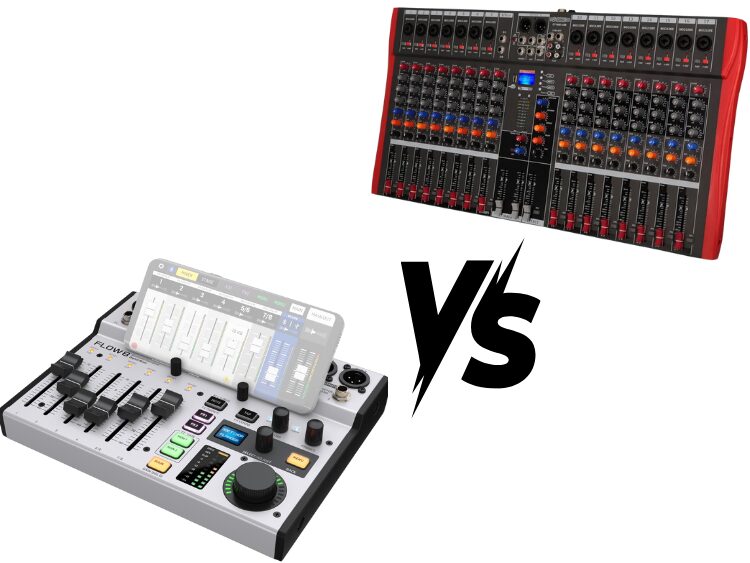
If you’ve ever shopped for an audio mixer, you already know the first question that smacks you in the face: Do I go analog or digital?
In the absence of an adequate audio mixer to properly route signals, balance levels, and shape the sound, even the best drum mic setup can go wrong. According to Gear4Music’s Live Sound Mixing Guide, the mixer serves as the focal point, controlling everything from panning and feedback prevention to gain staging and EQ, ensuring that every drum, cymbal, and microphone blends into a smooth live mix.
The tricky part? There’s no single “best” answer. Both camps have their fans, and both come with trade-offs. What matters is how you actually plan to use the thing. So instead of drowning in specs and sales jargon, let’s break it down in plain language.
What is an Analog Audio Mixer?
Analog mixers are the workhorses that you will come across in the clubs, studios, or even dusty church sound booths. These also have a series of knobs, faders, and switches directly connected to the audio signal.
When you twist a knob or a fader, you carve the sound out on the circuitry. No screens or menus, just simple hands-on control.
Why people still swear by analog mixers:
- Simplicity. What you see is what you get. Turn a knob,and the sound changes. Done.
- Tactile feel. Musicians love having real knobs and sliders under their fingers.
- Reliability. No crashing software or firmware updates to worry about.
- Tone. Many engineers describe the sound as “warm” and natural.
The trade-off? Analog mixers can get bulky. Plus, there’s no built-in memory or fancy effects—what you mix is what you get. If you mess it up, there’s no “undo.”
Digital Audio Mixer: An Explanation
Digital mixers convert your analog signal, either vocals, guitar, or drums, or anything other than these, to digital data immediately. After conversion into digital form, the mixer is able to add built-in effects, direct the audio in other ways, and apply preset settings.
Why digital mixers have exploded in popularity:
- Compact muscle. You can cram tons of channels and features into a much smaller box.
- Presets. Save your favorite mix settings and recall them instantly—a lifesaver for live shows.
- Built-in processing. Reverb, EQ, compression, delays—you don’t need racks of outboard gear.
- Connectivity. Most offer USB or Bluetooth, which makes recording and streaming painless.
The flip side? There’s a learning curve. If menus and small screens annoy you, digital mixers can feel overwhelming until you get used to them.
Analog vs. Digital Mixers
- Ease of Use: Analog wins ( just grab a knob and you’re set).
- Flexibility: Digital wins (effects, presets, routing).
- Sound Flavor: Analog often feels warmer; digital is super clean and precise.
- Portability: Digital usually packs more in less space.
- Price: Both digital and analog scales have a variety of options, which are appropriate for both in terms of beginners and professionals. The digital scales are, however, more expensive due to their additional capabilities.
Think of it like this:
- Want no-fuss, hands-on mixing? Analog’s your buddy.
- Want more features, recall, and recording built right in? Digital’s the way to go.
Product Spotlight
5 Core Professional 16-Channel Audio Mixer
The 5 Core MX-16CH audio mixer is a digital beast, built for folks who need serious power without hauling a rack of gear.
Key features:
- 16 Channels: Handle full bands, multi-host podcasts, or big live setups.
- USB Interface: Plug in directly to your computer and connect to record or stream.
- Bluetooth: Wireless connect phones or tablets and playback..
- Detailed EQ: Shape each channel exactly how you want.
- 48V Phantom Power: Essential if you’re using condenser mics.
- Durability: Sturdy, road-ready build that resists noise and interference.
If you’re a podcaster, DJ, or performer who needs one box to do it all, this mixer more than delivers.
Take full control of your sound with a mixer built to handle any setup.
Behringer FLOW 8 Digital Mixer – Product Description
The Behringer FLOW 8 is an 8-channel digital mixer designed for musicians, podcasters, and live performers seeking high-quality, versatile audio control in a compact package.
Key Features:
- 8 input channels with high-quality preamps for microphones and instruments
- Intuitive touch panel and wireless control via iOS/Android app for seamless mixing
- Built-in digital effects and comprehensive EQ settings to shape your sound
- Multi-track USB recording and playback functionality for versatile production
- Compact and portable design ideal for studio, stage, and mobile use
It’s the kind of mixer that shows why digital gear has become so popular—tons of functionality in a small footprint.
Get studio-level features in a compact mixer designed for life on the go.
So, Which One Should You Choose?
Here’s the straight talk:
- Go analog if you love simplicity, tactile controls, and don’t care about saving presets or adding effects.
- Go digital if you want flexibility, presets, built-in processing, and easy recording.
The digital tools are usually more useful to podcasters and other content creators. Musicians who like the feel of something physical and classic still tend to lean towards analog equipment.
Final Takeaway
Both analog and digital mixers earn their keep. The good news? You won’t go wrong with either, as long as you match the gear to your needs.
If you’re after an all-in-one pro solution, the 5 Core MX-16CH is hard to beat. If you’d rather start with something simpler, that Google Shopping digital pick gives you plenty of bang without the overwhelm.
The best mixer is the one that helps you stop fiddling with knobs and start creating.
Here you can find amazing drum thrones; alternatively, browse our product page to find the best keyboard bench, audio mixers, drum mics, piano bench, keyboard stand, speakers, party speakers, and more.