
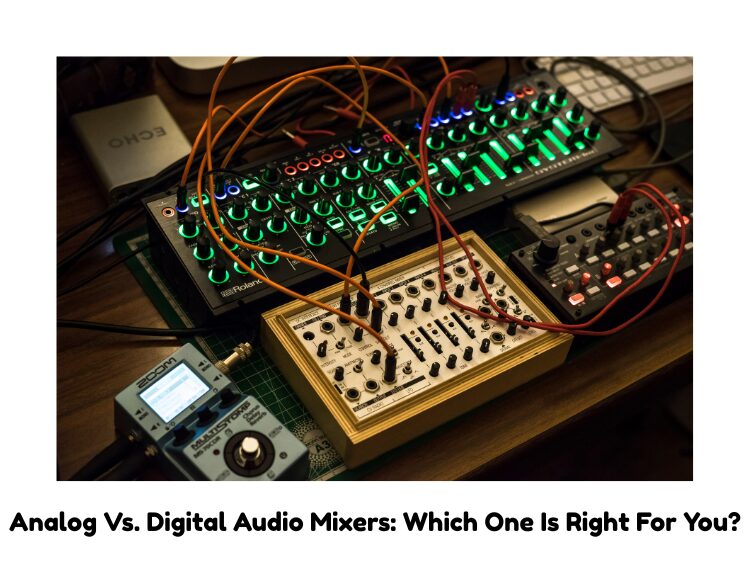
If you want to mix sounds, it might be hard to decide between analog and digital mixers. They both have their benefits and might work better in different situations. If you are an artist, a content creator, or an audio engineer, you should know the main differences between traditional and digital mixers so that you can pick the right one for your needs. This article will talk about the pros and cons of each type of mixer so that you can make an informed choice.
What is an Analog Mixer?
There are circuits in an analog audio mixer that handle and mix sound data. There are a lot of these mixers out there. Op-amps, resistors, and transistors are some of the parts that make the sound. The system takes sound from each channel and mixes it with sound from other channels. This is called “direct mixing.”
Pros of Analog Mixers:
Simplicity: If you already know how to mix music, analog mixers are easy to use because they have simple shapes and touch buttons.
Warm Sound: Many people like the “warmth” of analog gear because of the fuzz that comes from the physical circuits. If you want to make rock or jazz music, this trait can be helpful.
Reliability: When it comes to reliability, analog mixers are less likely to crash or have software problems because they don’t use complicated digital systems.
Cons of Analog Mixers:
Limited Features: Digital mixers are more flexible and have more features than analog mixers, such as automating or handling signals more efficiently. This isn’t possible with an analog mixer, even though they are simple.
Size and Weight: Digital mixers are generally smaller and lighter than analog ones. This might make live shows or sets that need to be moved around less useful.
No Recall Function: If you use an analog mixer, you have to change the settings by hand for each session because there is no recall function.
What is a Digital Mixer?
Digital audio mixers process and mix music with digital signal processing (DSP). These mixers take the sound waves and turn them into computer data. From there, software can be used to change the info. The mixer is now more adaptable and has more tools to help you fine-tune every part of the audio stream.
Pros of Digital Mixers:
Advanced Features: They come with a lot of effects, equalizers, compressors, and other tools already built in. A lot of them also have automation that lets you play back mixes that have already been set. This is useful for live shows and recording in the studio.
Compact Design: Digital mixers are smaller than their old versions because they use fewer actual parts. You can now carry them and store them more easily.
Flexibility and Customization: Digital mixers can be used for a lot of different audio needs and are easy to change to fit those needs because they have a lot of different workflow options, such as touch screens, remote controls, and the ability to update the software onboard.
Multi-Channel Input and Output: Digital mixers are flexible in complex live sound or studio environments because they can connect to and output to several channels.
Cons of Digital Mixers:
Learning Curve: Digital mixers have more features, but they can be hard to learn, especially for people who aren’t used to or aren’t familiar with audio mixing.
Possible Technical Problems: Software or code problems can happen with digital mixers, especially if they are not properly maintained. This could cause breaks or pauses during live shows.
Cost: Most of the time, digital mixers are more expensive than traditional mixers, especially high-end ones with lots of advanced features and functions.
For more tips on digital mixers and their features, visit our guide on how to connect an audio mixer to a PC for recording.
Which One Should You Choose?
Ultimately, the choice between an analog and a digital mixer depends on your needs, your budget, and how well you know how to use audio equipment.
Pick up an analog mixer if:
- You like simple designs that are easy to use and controls that you can feel.
- You work in small spaces where being able to move around and count on yourself are very important.
- You like the natural, full sound that analog gadgets can give you.
For those interested in analog mixers, you might also like to check out The Ultimate Buyer’s Guide to Audio Mixers Under $200.
Choose a Digital Mixer If:
- You need more powerful features, like the ability to record on more than one track, automate tasks, or use built-in effects.
- You work with bigger, more complicated setups or need to keep track of a lot of audio inputs and outputs.
- You need exact control because you know a lot about how digital gear works.
Conclusion
There are a lot of audio workers who love the basic, soft sound that analog mixers make. They work well and are easy to use. Digital mixers, on the other hand, are more adaptable, have more advanced features, and are simpler to add to modern audio systems. Consider your specific needs and how you like to work to find the best mixer.